What music was in your headphones and inspiring you whilst writing this record?
Annouli: Toxicity was a big one.
Hannah: Yeah, yeah. Toxicity for me definitely. We recorded this in September, October, and I had a transformative life experience at a System of a Down show in Chile and I was like, oh my god, and I recently saw them at the weekend, so they are very much at the forefront of the mind in terms of inspiration.
Why has music connected you three?
Jess: It just feels normal now. I feel like I can’t really remember what was before. It’s just always been music. We’ve been together a long time.
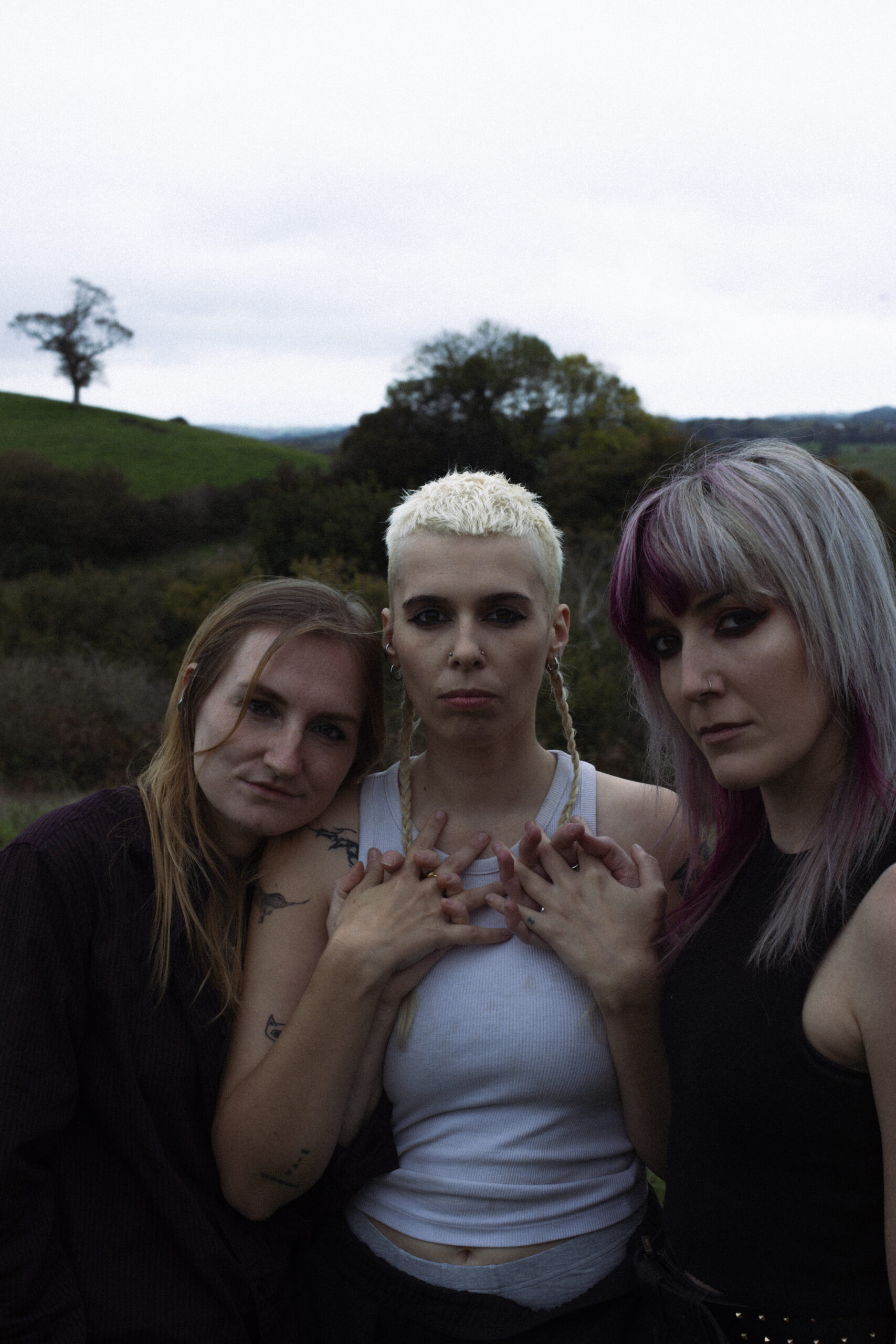
Annouli: Yeah, and we’ve all been musicians like our whole lives, you know, and so it’s the most natural form of expression. But I think that Hawxx gave us like a new level of expression in it all, thank fuck that we just have that, what would we even do without it? This band specifically, it gives us that container and permission to go completely outside of ourselves and become completely unhinged and feral and feel powerful, and be who we wouldn’t be in other situations, and welcome people in to do the same and feel the same. And so it’s a gift. It’s a real gift for all of us.
Jess: It’s so true, that thing of permission. Because this band is the first time I felt like I could suggest anything. And they’ll be like, well, of course. I guess we all have a bit of that, we can just do the thing that we’ve been maybe not so confident about doing before.
Hannah: I think music for me has always been, whether it’s conscious or not, a meditative thing, something to focus on in difficult times. But Hawxx is where I’ve been at my most expressive and my most feral. As we say, we’ve been musicians a long time, so we know what the instruments are and what they do, but to be able to channel a lot into those instruments in this body is absolutely amazing. And as Annouli said, a real gift.
What – aside from the state of the world – inspired the song Resistance Is Justified?
Annouli: Our music always balances the political and the personal, even on a track like Resistance is Justified, which is about the Filton 24. That was also really personal for me, because Jordan Devlin is my really close friend. He was doing work on my narrowboat, he was building shelves there, and then the next day he didn’t answer his phone, and he was in prison under the Terrorism Act. That case has been a huge part of my life over the last two years, and it still is. I was in the courthouse a lot, in the public gallery, and I wasn’t expecting Jordan to get acquitted, but then he did. It’s just terrifying, in terms of what happens when a government is afraid of its people, and it’s just been such a roller coaster, this entire thing.
Where did the song Feral Mother come from?
Annouli: Feral Mother is about grief. And it’s not the usual type of story that we tell. It’s about my cat Moses that went missing a year and a half ago now. I was basically living in the marshes here in Walthamstow in the middle of February, camping there, trying to find him and I thought I found him. But then it turned out that, after weeks of trying to catch this cat that I thought was him, it turned out to be a different cat that was nearly identical to him. And I never found out what happened to him. And he was the love of my life. But that song also spans outwards in terms of all kinds of grief, because sometimes I feel like, oh yeah, it’s about my cat. And not everybody understands how painful that is.
“"if this is sin, if this level of liberation and expression, and love and passion is sin, then sin is the truest thing that there is"”
Can you talk through the message found on Bind?
Jess: There’s too much to say. I think, on the face of it, like, it can be harmless. In theory everyone believes in this God, so they behave as themselves, and there’s a whole community. But I think the second you start to believe this thing that the leader is telling you, you become so vulnerable to be taken advantage of, in so many ways. It’s just so dangerous.
Annouli: It’s basically the voice of shame, if you know what I mean? It’s the ultimate voice of shame, and repression, that says anything you naturally are is wrong. Any desires you have, or who you want to be, or thoughts you have, it’s like your very essence is wrong. And that’s just so at odds with nature. That’s something that features a lot on our album, the natural belonging that you find in nature, like in Me and her and all the Birds, which is about where queerness finds its natural, beautiful home in nature. And that there is this belonging that you as an animal belong here exactly the same way as this tree. So then the idea that something is feeding you all this poison, that all you are is wrong, is so fucking dark and dangerous. And so that’s why we have that line in Me and her and all the Birds to say well, if this is sin, if this level of liberation and expression, and love and passion is sin, then sin is the truest thing that there is.
Why did you choose to finish with Be That Whore?
Annouli: In the song we’re talking about the whore in an ancient way, and in terms of our wider society. So if we look at history, and what role the whore has always played, especially within religion, because religion is of course a very personal topic as we’ve said. Me and Jess have both had experiences with Christianity and then coming out of Christianity, and that’s something that has bonded us in a very spiritual way, funnily enough, and through our liberation on every level, especially sexual liberation, and sexuality and queerness. But in this case, the whore has always been feared, because she represents being completely unlocked, total abandon. I think there’s a reason why in the apocalypse in the Bible, the whore is the one bringing the end times – even Christianity cannot handle the sheer power of the whore because she will dismantle all of the worlds that have been built in our society, through capitalism and techno-feudalism and all of these things that are keeping us imprisoned, and she demolishes all of those and builds new worlds. Ultimately it’s asking you to find how you can be the whore in every aspect of your life. That’s why it felt like the right track to close the album with, because it’s a perfect conclusion, to be that whore every goddamn way you can.
Hannah: Also, how do you follow Be That Whore? It’s just the epitome. Even conceptually, the guitar parts that I wrote, nothing is repeated, everything always escalates – which is the same concept as the whore, reinventing things all the time. It is just insane, this track. Everything’s always evolving and getting more and more wild. I love that.
Jess: It was so much fun to make this one. It was one that was really hard to put into a project on a computer because it’s such a live track, and when writing it we were just going with the flow, we just jammed it out. There was no question of ‘what’s gonna happen here?’ It was just pure carnage, jamming the instrumental stuff.
Ahead of the release you did a listening party at church – where did that choice stem from?
Annouli: It felt so right. First of all, this church is awesome, and I think I played in that church years ago. But the most recent thing I heard about this church was that a kink event was being hosted in the church, on the altar. And so I thought, this is sick, if these are the kind of energies that are welcome in this space, turning all of this on its head, then this is where we must do it. We had a drag queen host the event, and all of our heathen sacrilege songs playing on the big PA, or when I spoke about Bind and what that’s about, how it comes from such a dark and painful time in my life in my late teens, and being able to stand there with these guys and talk about what we made, made me feel so proud and powerful, and outspoken and expressive. Also being in the house of God, we felt like we changed what God means in our lives. Now, it means such a different thing. I’m a real fan of what it means now, it feels really healthy to be able to hold it in a space like that. But it wouldn’t be able to happen in any church, I think that one was the one that welcomes the strange creatures like us.
Jess: It was so amazing to blast out Be That Whore in a church, and it was loud. If I saw a church blasting that, it would be amazing, and the people walking outside must’ve thought, whoa, what’s going on in there?
Sacred Water is of course about water and our connection to it – why write a song about it?
Annouli: Water is life. More and more, it feels like our connection with the natural world is becoming severed and isn’t treated as a key part of our survival.It feels like our relationship with water is shrivelling. And what inspired that song was in the community where I live, where we all live on boats. One day, Thames Water flushed a load of sewage through our community, and for me, the wildlife here is a huge part of my life, I have really meaningful relationships with the foxes and the birds. I know all of the individuals that live here, all the creatures that live here. And suddenly, I have to wonder, are they going to survive? What’s going to happen? It’s the audacity of, yet again, the tale as old as time of profit over people, and profit over survival. It’s absolutely mad that we’re absorbing these decisions made by people higher up, because it’s becoming harder and harder to be able to go back to those real basics of clean air, clean water, good food. I’m sure many of us have thought about alternative lifestyles and how we can live in different ways, but this is becoming the most nature-depleted country in Europe, so a lot needs doing. It’s dire. But that song is also a love song to the water, and it does have that element of hope, where this ancient life form is always singing these songs that have existed forever long before we got here, and will continue to sing long after we’re gone. Beneath all of the destruction, there is life, there’s an aliveness. And that aliveness is something that we can tune into and bring with us, so in the song, we have that moment where it says ‘come alive’ – as we’re dying, as everything is falling apart, we can channel that aliveness. We can wake up to what is true, and live a story we’re proud to tell with our lives, in a meaningful way until it’s time for us to go.
It’s rough out there right now – what needs to change?
Annouli: I think the whole album is us asking the questions. And we’re not sitting here with any. I mean, who fucking has answers right now? I think that’s just the status of our times with what the fuck is going on. So I don’t know.
Jess: I think Elon should have to share his money with everyone.
Annouli: Of course he should. If the billionaires can do the right thing, then great, but they’re not going to. And that’s the thing. We know we’re not going to change the system. Nobody is going to change the system. It’s too deeply embedded, too far gone. So how can we build new small worlds in small ways? Whether that’s through small communities helping each other, or growing spiritually within ourselves. Find what it is in this world that makes you feel completely alive, and then go and do that – that’s the truest thing you can do. Because otherwise, we’ll all burn ourselves out trying to dismantle things that I think will not be dismantled in our lifetime, but I think there’s power in accepting that and seeing what is what is there here and now.
Hannah: I think there is a power of protest and collective action, but also change is possible, as we saw in COVID when there is impetus and need, you can shut these things down. And what we did see was like a real resurgence of nature, and things did clean up and things did right themselves a little bit. So, with the right pressure, or that buy in from the top, there is a chance for change. I think the worst thing people could do is get distracted and dissociated. I think as Annouli says, if you’ve got those collective communities and connections, I think that’s something to hold on to.